
The Biohacker's Guide to HBOT: What Bryan Johnson and the Longevity Community Know About Oxygen
When Bryan Johnson - the tech entrepreneur spending $2 million a year trying to reverse his biological age - describes hyperbaric oxygen therapy as one of the highest-value health therapies he has ever done, it's worth paying attention. Not because billionaire wellness experiments should be taken uncritically, but because Johnson does something most wellness influencers don't: he measures everything, publishes his data, and cites his sources.
His HBOT results, published in early 2026 after 60 sessions, are genuinely striking. And they sit within a broader conversation happening at the cutting edge of longevity medicine, a conversation that includes researchers, physicians, and performance optimisers who are increasingly treating oxygen not as a given background fact of existence, but as a powerful, precision-deployable therapeutic tool.
At OxyPlus, our hyperbaric oxygen therapy clinic in Newcastle, we think this conversation deserves to reach people outside the tech entrepreneur bubble. Because the science behind HBOT and longevity is real, the research is peer-reviewed, and access to medical-grade HBOT in Newcastle is not a $2 million proposition.
Who Is Bryan Johnson and Why Does His HBOT Experiment Matter?
Bryan Johnson is the founder of Blueprint, arguably the most documented, systematically measured human health optimisation project ever attempted. He sold his company Braintree to PayPal for $800 million and has since directed a significant portion of that wealth toward one goal: slowing and reversing biological ageing.
His protocol includes a strict plant-based diet, daily exercise, 111 supplements, and the continuous monitoring of over 100 biomarkers. After years of this regime, Johnson had achieved what his team described as elite-level biomarkers, and found it increasingly difficult to move the needle further with new interventions.
HBOT moved the needle.
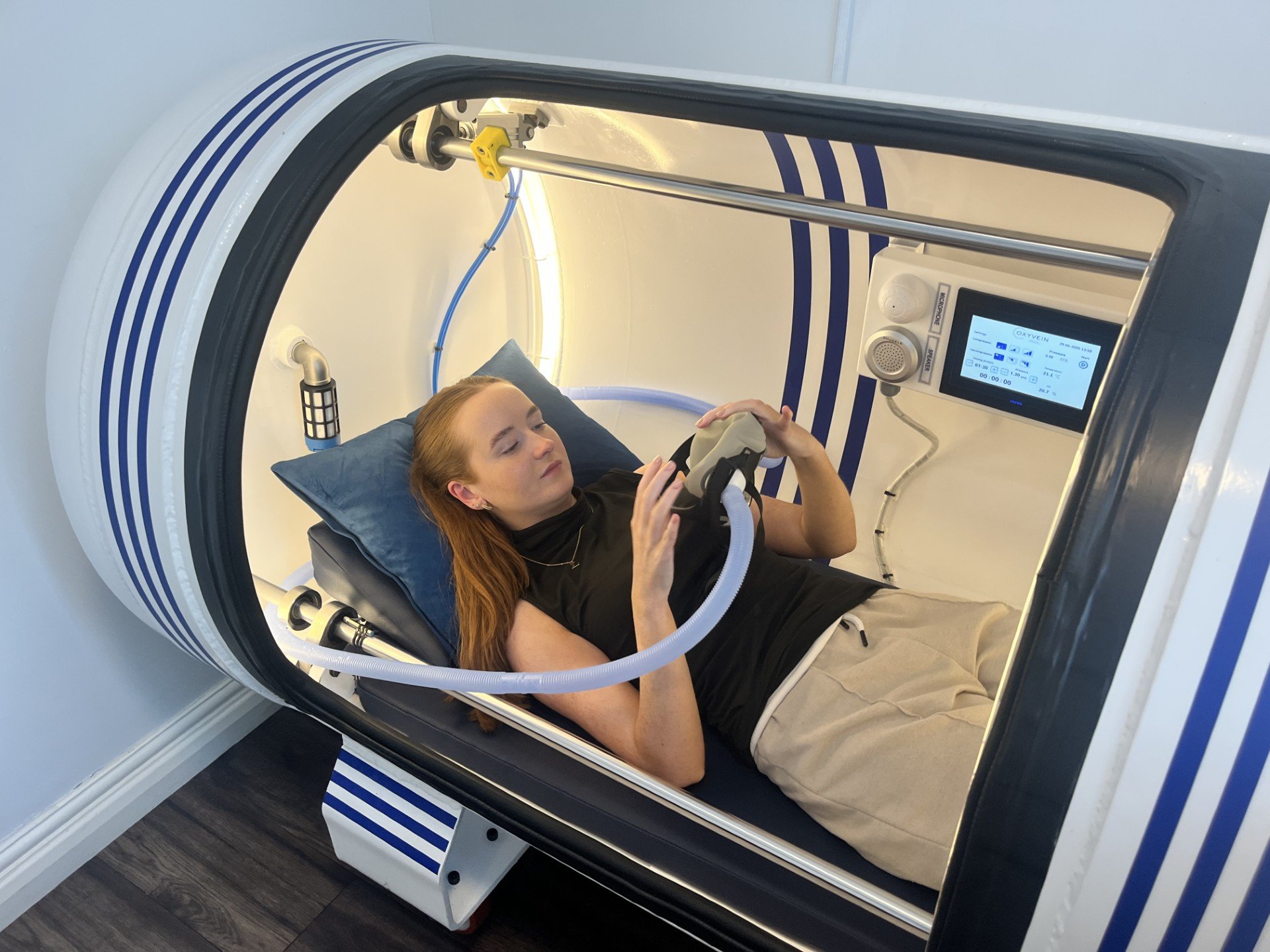
After completing 60 sessions of hyperbaric oxygen therapy between late 2024 and early 2025, Johnson published his results publicly. His protocol involved 100% oxygen at 2 atmospheric pressures, with 60 sessions at five per week, each lasting 90 minutes with 20-minute oxygen intervals and 5-minute air breaks, conducted in a medical-grade hard-shell hyperbaric chamber.
The results he documented were:
Systemic inflammation eliminated.
His hsCRP (high-sensitivity C-reactive protein, a key inflammatory marker) dropped to below detectable levels, wiping out all systematic inflammation in his body.
Telomere length extended.
His telomere length increased from 10.3 to 11.4 kilobases, a 2.6% extension.
Enhanced muscle oxygenation.
His testing revealed enhanced muscle oxygenation, achieving the same power output during exercise with more than double the oxygen levels in his muscle tissue.
He described HBOT as ranking as one of the highest-value health therapies he has done.
These are not vague subjective impressions. They are specific, measured biomarker changes from a person who tracks everything. And they align closely with what the peer-reviewed clinical research predicts.
The Science Behind the Hype: What HBOT Actually Does
The Hyperoxic-Hypoxic Paradox, Why the Cycle Matters
The central mechanism that makes HBOT interesting to longevity researchers is not simply "breathing more oxygen." It is what happens when you breathe high-concentration oxygen at raised pressure and then return to normal, repeatedly.
Under increased pressure, oxygen dissolves more effectively into plasma and penetrates tissues at higher concentrations, supporting cellular repair and regeneration. Simply increasing the concentration of oxygen breathed will not significantly increase the amount transported in the bloodstream, but increasing both atmospheric pressure and oxygen concentration causes tissue oxygen levels to rise significantly.
The repeated alternation between hyperoxia and return to normal creates what researchers call the hyperoxic-hypoxic paradox: the body interprets the relative drop in oxygen after a session as a hypoxic signal, triggering exactly the same adaptive responses that make altitude training, intermittent fasting, and high-intensity exercise beneficial. But through a different and complementary mechanism.
The result is the activation of HIF-1α, VEGF, PGC-1α, and SIRT1, a cascade of molecular signals that drive mitochondrial biogenesis, angiogenesis, neurogenesis, stem cell mobilisation, and anti-inflammatory responses. These are the mechanisms that the longevity research community cares about most deeply.
Telomeres: The Biological Clock
For longevity researchers, telomere length is one of the most watched biomarkers. Telomeres are the protective caps on chromosomes, they shorten with each cell division, and when they become critically short, cells either die or enter senescence. Telomere shortening is one of the established hallmarks of biological ageing.
The landmark Israeli clinical trial, the study Johnson cites most often, found that a 60-session HBOT protocol led to significant telomere lengthening in multiple immune cell populations. The research was conducted at 2.0 ATA with 100% oxygen. For context, home soft chambers at 1.3 ATA with ambient air produce roughly 1.5 to 2 times normal plasma oxygen levels, while clinical-grade HBOT at 2.0 ATA with 100% oxygen produces roughly 20 times normal plasma oxygen. These are not the same thing.
This distinction matters enormously for anyone comparing clinical HBOT to home soft chambers. The telomere research was done at clinical pressures and concentrations. Johnson's results, a 2.6% increase in telomere length, align with the published clinical evidence because he used the same parameters.
The broader research finding is even more striking: the Israeli trial found that HBOT increased telomere length by over 20% in some cell populations, significantly greater than any lifestyle intervention currently studied. Most interventions including endurance training, caloric restriction, and supplements show effects of 2–5% on telomere length at most.
Senescent Cell Clearance
Alongside telomere extension, the Israeli trial found that HBOT decreased the concentration of senescent cells (so-called "zombie cells" that accumulate with age, refuse to die, and actively damage surrounding tissue through inflammatory signalling) by 10–37% across different immune cell populations.
Senolytic therapies (interventions that clear senescent cells) are one of the hottest areas in longevity pharmacology. Drugs like dasatinib and quercetin are being studied for this purpose. HBOT appears to achieve comparable senolytic effects non-pharmacologically, a remarkable finding.
Inflammation: The Root of Biological Ageing
Johnson's most dramatic result was the elimination of measurable systemic inflammation. His hsCRP, a reliable marker of whole-body inflammatory burden, dropped to undetectable levels.
When Johnson spoke publicly about the biggest "unlock" in his health protocol, it wasn't a supplement or surgery. It was HBOT. And the inflammatory result is consistent with the mechanistic research: HBOT suppresses NF-κB, reduces pro-inflammatory cytokines including TNF-α and IL-6, modulates immune cell function, and breaks the hypoxia-inflammation feedback loop that chronic low-grade inflammation feeds on.
"Inflammageing", the term researchers use for the chronic low-grade inflammatory state that accelerates biological ageing, is now understood as one of the central drivers of age-related disease. Addressing it is a priority in virtually every serious longevity protocol. HBOT addresses it through multiple simultaneous pathways.
VO2 Max and Physical Performance
Johnson's finding of enhanced muscle oxygenation, achieving the same power output with more than double the oxygen in muscle tissue, points to a performance dimension of HBOT that is relevant beyond pure longevity.
VO2 max (maximal oxygen uptake) is consistently identified in longevity research as one of the strongest predictors of all-cause mortality, stronger than almost any other measurable biomarker. The ability of HBOT to improve oxygen delivery to working muscle, stimulate mitochondrial biogenesis, and promote angiogenesis in muscle tissue has direct relevance to VO2 max and the physical performance component of healthy ageing.
For people who exercise seriously and want to get more from their training and recovery, this is a meaningful consideration.
Cognitive Performance
Johnson's biomarker tracking for his HBOT experiment included neurocognitive markers, specifically P-Tau217 and S-100B, as well as cognitive performance assessments and brain function monitoring.
This reflects the growing recognition in longevity circles that brain health is not separable from physical health. The Israeli randomised controlled trial of healthy older adults found objective improvements in attention and processing speed correlated with measurable increases in cerebral blood flow on MRI, the same mechanisms Johnson's protocol targets.
The Honest Caveats: What a Biohacker's Guide Should Include
A credible guide to HBOT in the longevity context has to be honest about what the evidence does and doesn't show.
n=1 is not a clinical trial. Bryan Johnson's results are extraordinary and well-documented, but they are one person. Individual responses to HBOT vary. His results cannot be guaranteed to replicate in every individual, any more than any individual's response to any intervention can be.
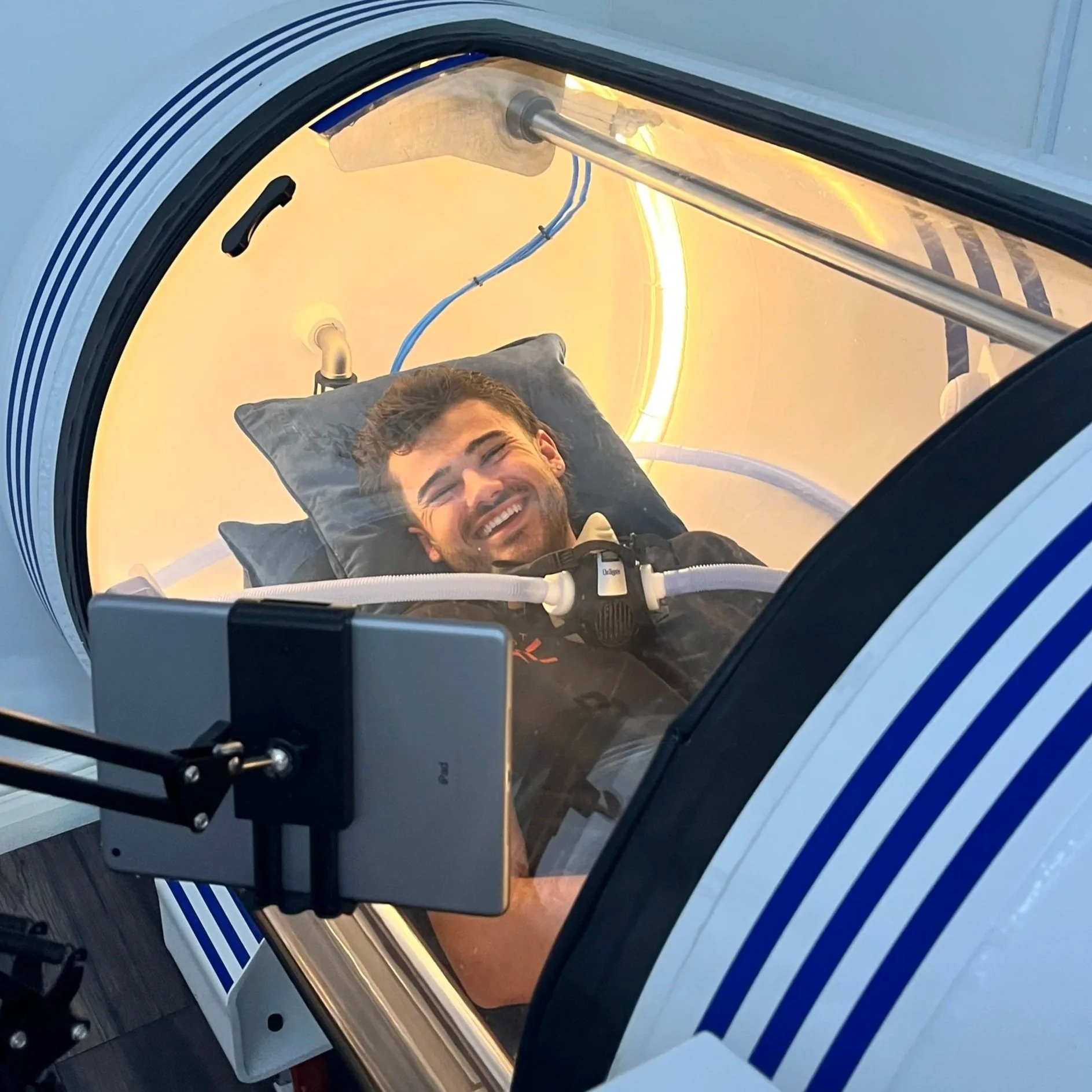
Clinical-grade HBOT is not the same as home soft chambers. Home chambers at 1.3 ATA with ambient air produce roughly 1.5 to 2 times normal plasma oxygen levels. Clinical-grade HBOT at 2.0 ATA with 100% oxygen produces roughly 20 times normal plasma oxygen. The longevity research, including the telomere trial, was conducted at clinical pressures. If you want the results the research demonstrates, you need clinical-grade equipment and parameters.
HBOT works best within a broader health framework. Johnson's results come on top of years of disciplined diet, exercise, sleep optimisation, and biomarker tracking. HBOT is not a shortcut past foundational health behaviours. It is, as the research consistently frames it, a powerful adjunct within a comprehensive approach.
Peter Attia's caution is reasonable. Not every longevity claim for HBOT is supported by the same level of evidence. The wound healing and TBI applications have the deepest evidence base. The longevity and cognitive applications have strong mechanistic rationale and growing clinical data, but the field is still developing. Intellectual honesty requires acknowledging this.
Consistency matters. Johnson completed 60 sessions over 12 weeks. The clinical trial protocols that demonstrated telomere changes also used 60 sessions. Doing 5 or 10 sessions and expecting similar results is not supported by the evidence.

The Biohacker's Quick-Reference: HBOT and Key Longevity Markers
Telomere length — Clinical trial: over 20% increase in some cell populations after 60 sessions. Johnson: 2.6% increase in 60 sessions.
Senescent cells — Clinical trial: 10–37% reduction in senescent cell concentrations after 60 sessions.
Systemic inflammation (hsCRP) — Johnson: dropped to below detectable levels. Research: significant reductions in TNF-α, IL-6, NF-κB pathway activity.
Cerebral blood flow — Clinical trial: significant increases in multiple brain regions on MRI, correlated with cognitive improvements.
Mitochondrial function — Research: stimulates PGC-1α and SIRT1, driving mitochondrial biogenesis and increased ATP production.
Stem cell mobilisation — Research: eight-fold increase in circulating stem cell markers after 20 sessions.
Muscle oxygenation — Johnson: same power output achieved with more than double the muscle oxygen levels post-HBOT.
Frequently Asked Questions
-
A: After 60 sessions of clinical-grade HBOT at 2 ATA with 100% oxygen, Johnson documented the elimination of systemic inflammation (hsCRP below detectable levels), a 2.6% increase in telomere length, and significantly enhanced muscle oxygenation. He described it as one of the highest-value health therapies he has done.
-
A: For the longevity and anti-ageing results demonstrated in clinical trials (including the telomere research Johnson references) you need clinical-grade HBOT at 2.0 ATA with 100% oxygen. Home soft chambers operate at around 1.3 ATA with ambient air, producing approximately 1.5–2 times normal plasma oxygen levels compared to roughly 20 times with clinical-grade equipment. These are not equivalent.
-
A: The landmark telomere trial, and Johnson's own experiment, used 60 sessions. Anti-inflammatory effects begin earlier — within the first 10–20 sessions. At OxyPlus Newcastle, we discuss a personalised protocol during your initial consultation based on your goals.
-
A: Yes. OxyPlus is Newcastle's specialist HBOT clinic, offering medical-grade hyperbaric oxygen therapy at clinical parameters the same as used in the longevity research. We serve clients across Newcastle and the wider North East. Visit the book now section to book your consultation.
-
A: HBOT has a well-established safety record when conducted in a properly equipped clinical setting under appropriate supervision. There are some contraindications, which is why every OxyPlus client undergoes a thorough health consultation before beginning. We always recommend discussing HBOT with your GP as part of your broader health picture.